
Most Perth households own a car that’s excellent at one thing. The ute that’s brilliant on a job site in Malaga but a nightmare in the Garden City car park with two kids and a trolley. The compact hatch that’s perfect for the Mitchell Freeway commute but wheezes up the hill to the Kalbarri lookout with a boot full of camping gear. The seven-seater that swallows the whole family but spends five days a week ferrying one person to an office in West Perth.
The trick isn’t finding a vehicle that’s the best at any one of those jobs. It’s finding the one that does all three well enough that you stop wishing you had a different car every other day. Rather than a general list of features, this guide looks at the three lives most vehicles have to lead, what each one demands, and where they overlap.
Australians Already Own a Lot of Cars, and Still Want the Right One
The multi-vehicle household is the norm, which tells you something about how hard it is to find one car that does everything. According to the Australian Bureau of Statistics, 55.1 percent of Australian households reported owning two or more motor vehicles in the 2021 Census, and the average household owned 1.8 vehicles.
For many families, a second or third vehicle is really a workaround for a first one that doesn’t cover enough ground. Choosing well the first time can save the cost of the workaround.
Life One: Monday to Friday, Work
Whatever the job, the work week asks the same things of a vehicle:
- Fuel and servicing over 15,000 to 25,000 kilometres a year add up fast; a diesel or hybrid can matter more than the purchase price
- A commute or a day on the road in a seat that’s wrong is a slow form of punishment
- Whether it’s tools, samples, a laptop bag, or a boot full of client files, the vehicle needs to carry the trade
- A car that looks tidy on a client’s driveway is part of the job for many people
- A vehicle that fails to start costs a day’s income, not just a tow
Vehicles that excel here are usually mid-size SUVs, wagons, and dual-cab utes with decent cabins, depending on how physical the work is.
Life Two: The Family Weekend
Saturday morning brings a different set of demands:
- Seats and seat anchors. Enough positions for every child, with ISOFIX and top tethers where the seats actually go
- Wide-opening or sliding rear doors, and a floor height that doesn’t require lifting a toddler overhead
- Boot capacity. Pram, sports bags, groceries, and the dog, all at once
- A recent ANCAP rating with autonomous emergency braking, blind-spot monitoring, and rear cross-traffic alert
- Durability of the interior. Wipeable surfaces and fabric that survives juice, sand, and crayons
Here the seven-seaters and larger SUVs shine, though a well-packaged mid-size SUV or wagon covers most families of four.
Life Three: The Escape
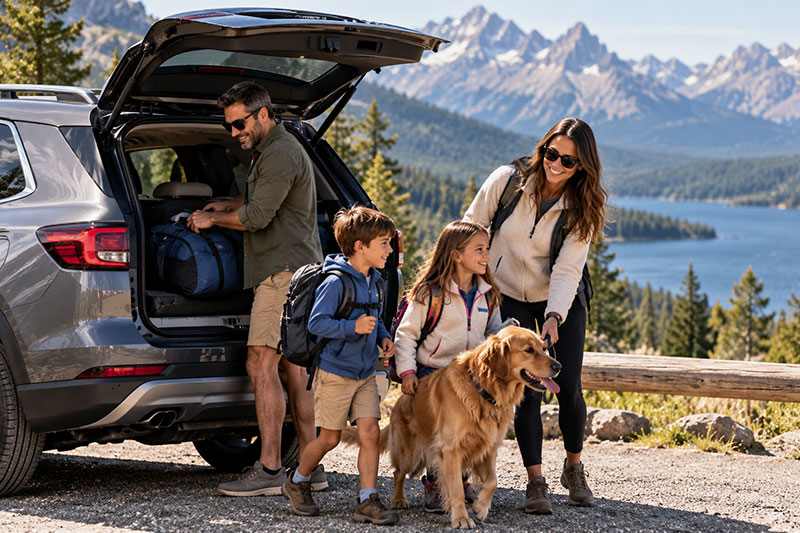
The third life is the one that makes the other two bearable: the long weekend down south, the camping trip north, the drive to the coast with a board on the roof:
- Range and towing. Enough fuel range for regional distances, and towing capacity if a camper trailer or boat is in the picture
- Ground clearance and drive. All-wheel or four-wheel drive, or at least clearance for gravel access roads
- Roof and load options. Roof rails, a tow bar, and a boot that takes a fridge and a swag
- Highway manners. Stability and cruise control for hours of straight road
- A vehicle that shrugs off dust, corrugations, and salt air
Dual-cab utes, larger SUVs, and some all-wheel-drive wagons are the natural choices, and this is where a family car most often falls short.
Where the Three Lives Overlap
Lay the three lists side by side and a shortlist emerges. Mid-size and large SUVs with all-wheel drive, decent towing, a recent safety rating, and a comfortable cabin cover most of the ground. Dual-cab utes with a canopy do the work and the adventure superbly and, in modern form, handle family duty far better than they used to. Wagons are the underrated option, practical and economical, if towing and clearance aren’t priorities.
For most buyers, the best balance of capability, safety, and price lives in the used market, where a three-to-five-year-old vehicle from the right category offers features that were top-of-the-range not long ago at a fraction of the new cost. Browsing the cars for sale Perth buyers are choosing for this kind of triple duty, from all-wheel-drive SUVs to dual-cab utes and wagons, is a sensible starting point.
Carmart Perth deals exclusively in quality used vehicles, which suits the three-lives buyer well: Every car is inspected before sale, service histories and PPSR checks are available, and the team is used to helping customers weigh a ute against an SUV based on how they’ll actually use it rather than on what’s newest on the lot. Bring the child seats, the surfboard measurements, and an honest account of the work week, and a good used-car dealer will help find the overlap.
Testing the Overlap Before You Buy
Before committing to a vehicle, it is worth testing how well it fits your family’s real-world needs rather than relying solely on specifications or appearances. Take the time to check:
- Take the longest test drive available, ideally with a stretch of highway and a rough road
- Fit the child seats and load the boot with the real gear
- Check towing capacity against the actual trailer or boat weight, not the brochure
- Confirm the service history and roadworthy inspection
- Price insurance, registration, and fuel for a year before committing
A thorough check before purchase can reveal practical limitations early and help ensure the vehicle works for your family, budget, and everyday needs.
Conclusion
Choosing the right vehicle for work, family, and weekend adventures means refusing to buy a car that’s brilliant at one life and a compromise in the other two. Map what the work week, the family weekend, and the escape each demand, look for the categories where those demands overlap, and test the vehicle against all three before signing.
With most Australian households already running two or more cars, often because the first one doesn’t stretch far enough, getting the choice right can save a second purchase entirely. The right vehicle is the one that’s on the job site on Monday, at the school gate on Saturday, and halfway to the coast on Sunday, without anyone wishing they’d brought a different car.