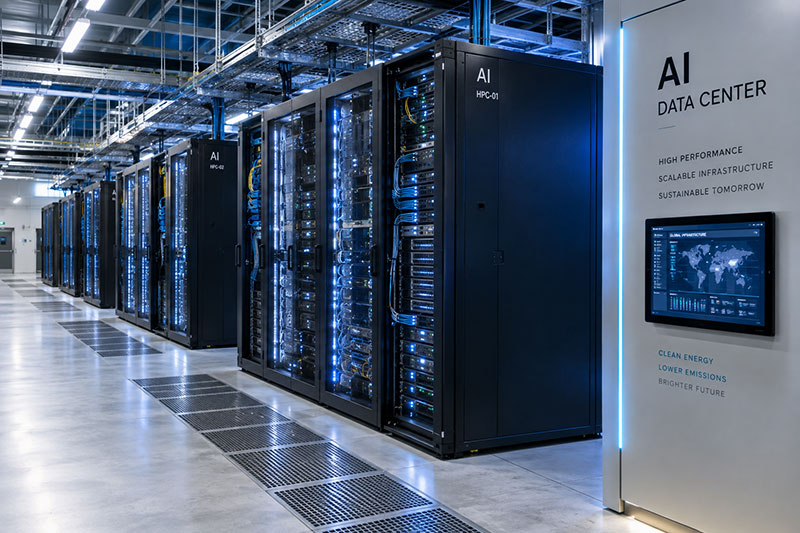
Calls to pause data center construction and slow AI development may be growing louder, but one problem remains: the world’s demand for computing power isn’t slowing down anytime soon.
Data centers have become one of the most controversial developments popping up across the American landscape.
Coast to coast, communities are worried about data centers’ impact on electricity bills, water consumption, noise pollution, disappearing farmland, and massive facilities showing up in their backyards.
Add in the triple power demand expected in the next 5 years due to the onslaught of AI, and it’s no wonder the two words put together can raise hackles at even the most benign dinner party.
In the past six months alone, lawmakers and the residents they represent have been pushing for moratoriums and new restrictions on data center development, all in an attempt to alleviate those growing concerns.
Even leaders at the world’s biggest AI companies this week have suddenly proposed slowing down the technology itself, fearing a loss of control over their own frontier LLMs.
Those concerns shouldn’t simply be dismissed. But neither should the reality staring us in the face.
The world needs more computing power than ever before – and that demand isn’t going away.
Every ChatGPT prompt, Google search, streaming video, cloud application, financial transaction, and connected device – whether used by an individual or a corporation – relies on data centers and the computing power they produce.
And whether we like them or not, we’re demanding more of what they provide every day.
Slowing frontier AI won’t stop demand
Last week, three Anthropic researchers made headlines warning that AI could lead to human extinction, possibly within the next few years.
That, along with a plethora of rogue AI incidents in recent months, it appears, led CEO Dario Amodei, OpenAI CEO Sam Altman, and their cohorts to sound the alarm on pacing the development of their increasingly capable AI systems.
And even though no one is stopping them (except maybe their investors), we must acknowledge that attempting to slow down AI’s eventual evolution is not the same as reversing the adoption of artificial intelligence that has already taken place.
AI is already being integrated into businesses, government agencies, cybersecurity systems, search engines, software platforms, healthcare, education, transportation, and everyday consumer products.
Companies aren’t suddenly going to rip AI out of their digital environments. Consumers aren’t going to collectively stop using AI assistants.
And the world’s appetite for cloud computing, streaming, social media, connected devices, digital services, and the mountains of data behind all of them isn’t disappearing either.
In fact, analysts have already made this distinction: slowing the growth of advanced AI doesn’t necessarily mean infrastructure spending collapses, especially while demand for AI computing and the data centers that power it remains high.
Then there’s the national security problem
President Donald Trump, not one to shy away from commenting on, well, everything, jumped into the debate this week and made it clear he was not a fan of this newfound about-face.
“We’re leading China in AI, we’re the most sophisticated country in the world. And frankly, I want to keep it that way because whoever wins AI, wins,” the President said over the weekend.
And admittedly, I don’t entirely disagree.
From semiconductors and robotics to military weapons, surveillance equipment, and satellites, allowing China to get ahead in the AI wars would impact not just our national security and economy, but that of the world on a scale of unimaginable magnitude.
Imagine a future in which the US is dependent on China for the world’s most advanced AI systems, or other critical technologies.
And what happens when China sells that advanced technology to nation-state adversaries like Russia or Iran?
That’s not simply an economic problem. It’s a national security nightmare.
You can’t regulate away demand
None of this means communities should simply accept every data center proposal put in front of them.
Where these facilities are built matters; who pays for the electricity infrastructure matters, and environmental impact matters.
Residents have every right to demand answers before enormous industrial facilities move into their communities.
But the larger reality is that demand exists at every level.
Individuals are demanding more computing power. Businesses are demanding it, governments are demanding it, entire economies are demanding it – and that’s not going to stop as technology makes its way into every nook and cranny across the globe.
We can demand cleaner energy, better cooling technologies, smarter construction, stronger community protections, and require trillion-dollar technology companies to shoulder more of the infrastructure costs they create.
What we can’t do is pretend that stopping construction will somehow eliminate that underlying demand.

Stefanie Schappert is a Senior Journalist at Cybernews covering cybersecurity, AI, national security, cyber policy, critical infrastructure, data privacy, and the human impact of technology. Based in New York, she is the first American journalist at Cybernews and a broadcast news veteran previously at Fox News, NY1 News, and Verizon FiOS 1. She holds a Master’s degree in Cybersecurity and is ISC2 Certified in Cybersecurity (CC). A guest commentator on TV, radio, and podcasts, including CBS News, iHeartMedia, and KTLA, Schappert explores how technology and cyber risk shape society, from ransomware attacks and hacker groups to emerging technologies and digital policy. She has been published in Fortune and cited by the US Senate, FCC, HHS, Henry Jackson Society, academic institutions, and other leading technology publications.