
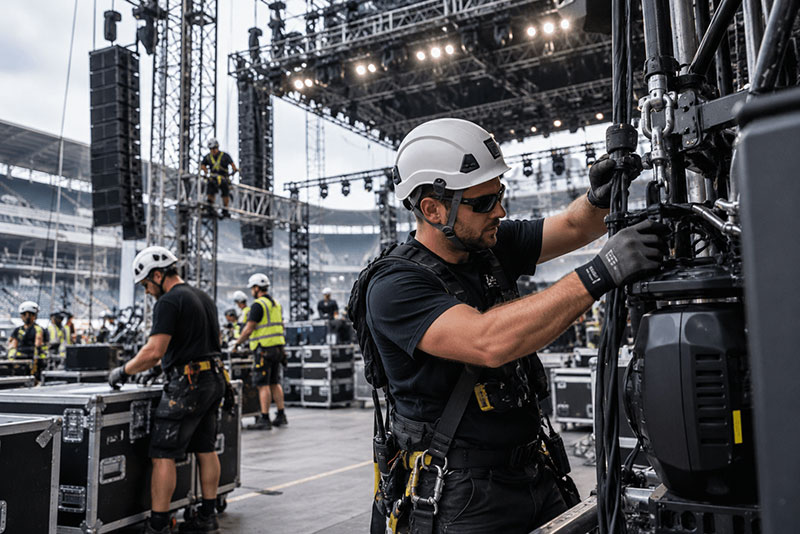
The failure never happens at a convenient moment. It happens at 2 a.m. on a shipyard pier with a vessel due to sail at dawn, or forty minutes before doors open at an outdoor concert, or mid-pour on a construction site where the concrete truck is already backing up. A connector that’s been dragged across gravel one time too many finally gives out, a cable jacket that was never rated for the environment cracks and lets water in, and a distribution panel that looked fine on the invoice trips and won’t reset. The crew stands around. The clock runs. And the money saved on the equipment three years ago evaporates in an hour.
Power distribution gear rarely gets the attention it deserves because, when it works, nobody notices it. This article makes the case for treating it as the critical infrastructure it is, and for buying it accordingly.
The Grid Itself Is Getting Less Predictable
Even businesses with reliable utility service are experiencing more disruption than they used to. According to the U.S. Energy Information Administration, electricity customers in the United States averaged 11 hours of power interruptions in 2024, nearly double the annual average of the previous decade, with hurricanes accounting for roughly 80 percent of those outage hours.
For businesses that rely on temporary power, generator backup, or portable distribution to keep operating through weather and grid events, that trend shifts the question from “will we need this equipment?” to “will it hold up when we do?”
The True Cost of Cheap Gear
The purchase price of a cable, connector, or distribution panel is the smallest number in its lifecycle. The larger ones are hidden:
- Downtime. A single failed connection can idle an entire crew, a production line, or an event. The hourly cost of that stoppage typically exceeds the price difference between economy and industrial-grade equipment many times over.
- Replacement frequency. Equipment not rated for its environment is replaced repeatedly. Three cheap cables over five years usually cost more than one durable one, before counting the labor to swap them.
- Safety incidents. Compromised insulation, corroded contacts, and poorly molded connectors are the precursors to shocks, arc flashes, and fires. The cost of one incident, in injury, liability, and investigation, dwarfs any equipment budget.
- Compliance exposure. Inspectors, insurers, and clients increasingly expect UL or cUL listed components. Uncertified gear can halt a job or void coverage.
- Reputation. The contractor whose power failed, the venue that went dark, the yard that missed a sailing: these are the stories customers remember.
What “Durable” Actually Means
Durability in power distribution is specific and measurable. The features that separate industrial-grade equipment from the rest:
- Jackets and insulation rated for the environment, including oil, abrasion, UV, chemicals, and extreme temperatures
- Waterproof, multi-pin, or cam-type connectors designed to stay sealed under repeated mating and exposure
- Strain relief and molding that keep conductors and contacts secure through thousands of connections and disconnections
- Correct ampacity and voltage ratings with margin, not marginal sizing that runs hot
- Third-party listing (UL/cUL) and ongoing audits, which verify the product performs as claimed
- Domestic manufacturing and quality control, so consistency is traceable batch to batch
Equipment built to these standards is designed to be pulled, coiled, stepped on, rained on, and connected under load for years, because that’s what actually happens to it.
Choosing Equipment Built for Real Conditions
The gap between marketing language and engineering shows up in two places: where a product is made, and how it’s tested. When comparing power cables, connectors, or portable distribution panels, the useful questions are about provenance rather than features.
- Is molding and assembly done by the manufacturer or outsourced?
- Is the product listed by a recognized testing laboratory, with that listing maintained through ongoing audits?
- What environments has it actually been proven in?
Manufacturers with long histories in the hardest applications tend to answer those questions easily; Duraline, for example, has produced this category of equipment in Florida since the 1940s and counts the U.S. Navy and commercial shipyards among its customers, which says more about durability than any brochure. Whichever supplier a business chooses, the principle holds: equipment that has survived shipyards and mine sites for decades will survive a job site or a backup power plan.
A Practical Evaluation Checklist
Before purchasing any power distribution equipment, ask:
- What environment will it live in, and is every component rated for that?
- How many connect/disconnect cycles is it designed to withstand?
- Is it listed by a recognized testing laboratory, and can the listing be verified?
- Who manufactures it, where, and how is quality controlled?
- What does the warranty cover, and how quickly are replacements available?
- Will it interoperate with existing connectors and panels on site?
- What does one hour of downtime cost, and how does that compare to the price difference?
The last question usually settles the decision.
Durability as a Planning Tool
Reliable equipment doesn’t just prevent bad days. It enables better planning. Crews can be scheduled without contingency time for gear failures. Backup power can be tested and trusted.
Events can be run with confidence in the electrical backbone. Insurance and compliance conversations get shorter. Over a decade, the operational calm that comes from equipment that simply works is worth more than any line-item saving.
Conclusion
Businesses should invest in durable power distribution equipment because the alternative is paying for it anyway, in downtime, replacements, safety incidents, compliance problems, and lost trust, usually at the worst possible moment.
With grid interruptions at their highest level in a decade and more operations depending on temporary and backup power, the cables, connectors, and panels that carry that power have become genuine infrastructure. Buying gear that’s built, listed, and proven for harsh conditions turns a recurring risk into a solved problem, and lets the 2 a.m. call be about something else.